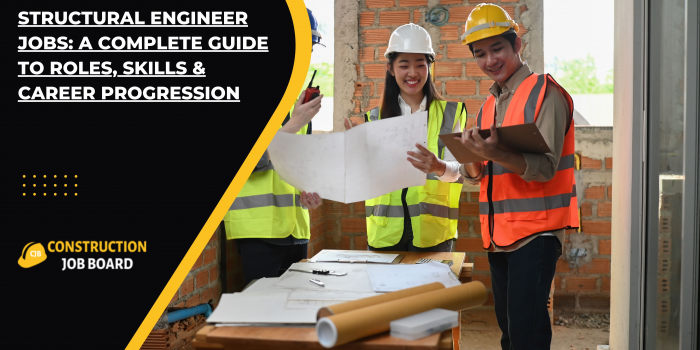


If you are building a career in the technical design of the built environment, structural engineer jobs offer one of the most intellectually demanding and professionally rewarding pathways in UK construction and engineering. Structural engineers are responsible for ensuring that buildings, bridges, tunnels, and other structures can safely withstand the loads and forces they will encounter throughout their lifespan. They design foundations, frames, floors, roofs, and retaining structures, and they assess the structural integrity of existing buildings when changes of use, extensions, or deterioration require investigation.
Authority in structural engineering flows from technical rigour, professional qualification, and demonstrated judgement under conditions of uncertainty. The structural engineer who has earned Chartered status — CEng through the IStructE or ICE — is recognised across the industry as having met the highest standards of technical competence and professional practice.
Structural engineers analyse the forces acting on a structure (gravity loads, wind loads, seismic effects, thermal movement, dynamic effects) and design structural members and connections capable of resisting those forces safely and efficiently. They work from architect's concept designs, developing structural schemes using hand calculations and advanced structural analysis software (ETABS, STAAD.Pro, Robot Structural Analysis, Tekla). They produce structural drawings and specifications, coordinate with other design disciplines, and provide technical oversight during construction.
Many structural engineers specialise. Building structural engineers focus on residential, commercial, or industrial buildings. Civil/structural engineers work on bridges, retaining walls, culverts, and earthworks. Offshore structural engineers design platforms and subsea structures for the oil, gas, and offshore wind industries. Geotechnical engineers specialise in foundation design and ground investigation. Fire engineers apply structural principles to the behaviour of structures under fire conditions.
The standard educational route is a BEng or MEng in Civil or Structural Engineering (or a closely related discipline) from a university with accredited programmes. An MEng or a BEng followed by an MSc is generally preferred for the Chartered Engineering (CEng) route through the Institution of Structural Engineers (IStructE) or Institution of Civil Engineers (ICE). Chartership requires a period of structured professional development (typically four to six years post-graduation), a detailed written submission, and an interview before a panel of Chartered Engineers.
Structural engineers frequently collaborate with site managers and quality control professionals during construction to ensure that structural work is executed as designed. An understanding of construction methods and sequencing enhances an engineer's ability to produce buildable designs and adds significant value to clients.
Graduate structural engineers typically earn £28,000 to £35,000. Engineers at Incorporated (IEng) or pre-Chartered level earn £40,000 to £55,000. Chartered Engineers (CEng) command £55,000 to £80,000. Associate Directors and Directors at consultancy practices earn £80,000 to £130,000 and above. Specialist engineers in offshore, nuclear, or defence earn premiums reflecting the complexity and criticality of their work. Contract structural engineers with CEng status typically earn £400 to £700 per day.
The growing importance of Building Information Modelling (BIM), digital twins, and parametric structural design is reshaping the skills required of structural engineers. Engineers who combine strong analytical fundamentals with digital design proficiency — using Grasshopper, Dynamo, or Python for structural optimisation — are highly sought after. Sustainability is also driving demand for structural engineers skilled in embodied carbon assessment, mass timber design, and adaptive reuse. These trends intersect with the broader construction skills agenda and with the work of estimators who need to cost novel structural solutions accurately.